
Ex-Supergoop Exec Takes On Scars With New Brand Built On Bioengineered Bee Protein Leave a comment
After four years of cancer treatment that involved nine hospitals, 182 rounds of oral chemotherapy, 36 rounds of infused chemotherapy, two ICU visits and two goodbyes to her family, Lindy Firstenberg’s port scar was a painful artifact of a period of her life she desperately wanted to move beyond.
She tried practically everything to reduce it, from silicone patches and lasers to acupuncture, herbs and oils, without success. “I think I bought out the entire CVS aisle,” she says. “And it was keloided and really angry and very, very much a daily reminder of dying and what dying felt like.”
As Firstenberg, in remission today, kept hunting for solutions, her husband, Sam Thomas, then working at Supergoop, where he had risen from chief of staff to AVP of accounts, received a call about a new recombinant protein ingredient technology being pitched to him for post-sun skin repair. With his wife top of mind, he wondered whether it could also help improve the appearance of scars.
Firstenberg began applying a gel with the ingredient, and the results were unlike anything she’d experienced with other treatments. Her once-red, raised scar became barely visible. She says, “Now it’s almost like an invisible tattoo where I got to keep a little bit of it because it’s a total badass battle wound.”
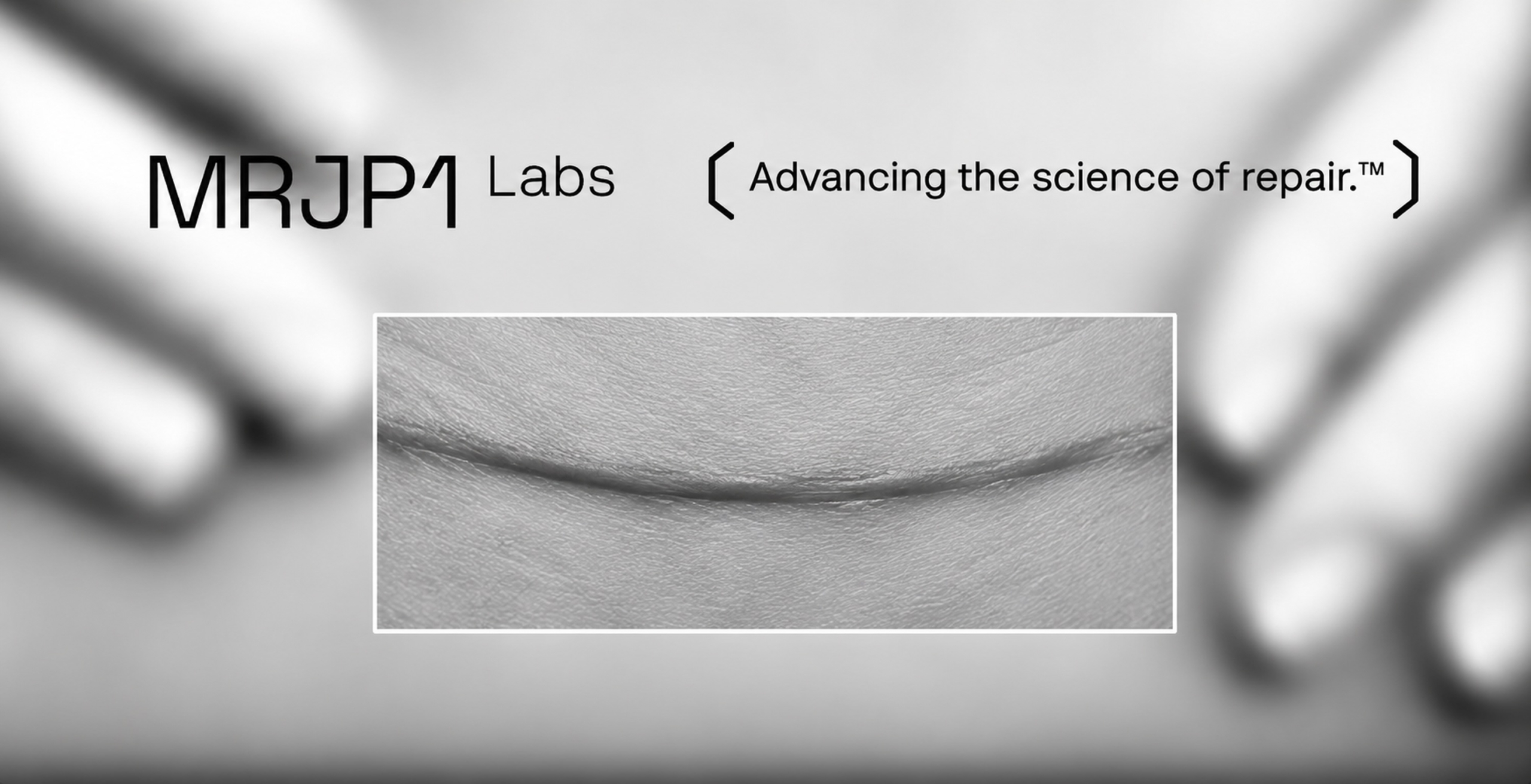
Now, Thomas is preparing to launch MRJP1 Labs, a personal care brand named for the recombinant protein ingredient at the center of its formulations. Scheduled to debut in fall 2027, the brand will introduce two products, ScarGel and StretchSerum, with a mission to restore trust in a category where consumers have been disappointed by products and services that haven’t delivered on their promises.
“A product that works returns agency to people in an area that they have absolutely no trust,” says Thomas. “The entire brand is built around that principle of trust moving person to person and not through a brand.”

MRJP1 Labs operates under SL Molecule, a company majority-owned by Thomas and Firstenberg, who co-leads the beauty, health and wellness practice at AlixPartners but has no day-to-day management responsibilities at the brand. SL Molecule has secured exclusive distribution rights in the United States to the recombinant protein ingredient from an undisclosed strategic partner that owns the technology and its intellectual property.
According to Thomas, the agreement runs through the life of the patent, which he says expires in 2040, and provides a path to international expansion. The strategic partner is a minority investor in SL Molecule, with the remainder of the company’s outside investment coming from friends and family. SL Molecule is currently seeking $2 million in funding and has secured roughly three-quarters of that amount. Thomas expects the capital to support MRJP1 Labs through its first 18 to 24 months following its planned commercial launch.
MRJP1 stands for major royal jelly protein 1, known as royalactin, a naturally occurring protein found in royal jelly produced by honeybees. Although the ingredient has its origins in royal jelly, MRJP1 Labs’ formulations don’t contain honey. Instead, they incorporate a recombinant version of the protein created through genetic engineering by its partner’s scientists, who have spent more than a decade researching the technology.
Thomas explains that scientists isolated MRJP1 and developed a smaller molecular version intended to stimulate fibroblast proliferation, the process by which cells responsible for producing collagen and elastin multiply. The goal is to accelerate the skin’s repair processes and promote healthier tissue regeneration to diminish scars and stretch marks.
“A product that works returns agency to people in an area that they have absolutely no trust.”
To document the ingredient’s effects on real people’s scars, MRJP1 Labs is enlisting participants in an initiative it’s dubbed the 100 Scar Project. The project encompasses a wide variety of scars, ranging from C-section scars to those left by injuries and medical procedures, with participants recruited through physicians, physical therapists, social media and personal networks. Participants receive products to use over several months in exchange for capturing changes in their scars.
Firstenberg says, “If we can show a library of evidence and build a library of hundreds of people who have used this product pre-launch, it’s so much more powerful than any type of marketing or branding that we can do.”
In fact, MRJP1 Labs is minimizing branding, emphasizing the ingredient and its results over the brand itself. Its visual identity is restrained, relying on a black-and-white color palette with gold accents in a nod to the color of the ingredient. Showcasing the molecule front and center in the name, much as K18 has done with its proprietary peptide technology, is part of the effort to let the ingredient and products speak for themselves.
“We’re throwing out all traditional principles. It’s truly the products, everything should be about the product and the molecule,” says Firstenberg. “The brand just fades into the background.”

MRJP1 Labs has yet to finalize pricing for its products, but the high cost of producing the recombinant protein makes mass-market pricing difficult. However, the cost of goods could decline as production of the ingredient increases. The brand is structuring protocols around the type and age of consumers’ scars. Thomas anticipates that a typical protocol will last three to four months and could be priced at $300 to $500 in total, with final pricing and protocols informed by the 100 Scar Project and upcoming clinical testing.
MRJP1 Labs is targeting gross margin percentages in the 70s, but Firstenberg acknowledges that achieving them could be tricky given the ingredient’s production costs. In addition, she points to the expense of launching a new brand in an established category and reaching consumers through dermatologists and direct marketing.
At the outset, MRJP1 Labs is focusing on direct-to-consumer distribution and is looking to generate $3 million to $5 million in sales over its first 18 to 24 months. That period would allow the brand to demonstrate proof of concept for ScarGel and StretchSerum before expanding distribution.
Beyond ScarGel and StretchSerum, MRJP1 Labs sees opportunities in acne scar treatments and everyday first aid. Thomas envisions eventually challenging Neosporin with a product containing MRJP1 for cuts, scrapes, wounds and burns, potentially in an easy-to-apply stick format. The ambition is to transform the first aid aisle.
Showing the ingredient’s effectiveness on scars and stretch marks is the first step toward realizing those larger ambitions. “If you prove it there, it raises enough eyebrows that people will be like, ‘Oh, this can solve old and new scars and stretch marks. OK, now you have our attention,’” says Thomas. “So this is about how do we get people’s attention by actually showing them the thing works.”
