
Former Amazon Product Manager Aprajita Lavania Launches LAVANAĒ To Bring Ayurveda’s Systems Thinking To Luxury Skincare Leave a comment
LAVANAĒ, a luxury skincare brand from former Amazon technical product manager Aprajita Lavania, launched this week with a plan to push Ayurvedic beauty past ingredients and rituals and into what she calls “system-led skincare.”
Lavania grew up in a town of fewer than 25,000 people in Uttarakhand, a Himalayan state in northern India, where amla, turmeric and other traditional Ayurvedic botanicals grew in her backyard. She used them to make DIY face masks for the acne that began in her teens. After moving to the United States in 2016 to earn a master’s in engineering at Virginia Tech, she lost access to those ingredients, and the stresses of her new life made her breakouts worse. She says, “I was looking for products here that aligned with my thinking of holistic beauty.”

Ayurveda, the Indian healing system dating back more than 5,000 years, looks past symptoms to their root causes and treats the brain, gut and skin as interconnected. Lavania wanted skincare grounded in that idea while delivering fast results from clinically validated modern actives. She couldn’t find it. In 2024, postpartum hormonal changes made her skin worse, prompting her to build the brand herself. “Ayurveda has so much to offer,” she says. “We need to update that for the modern skin and package it in a way that works for the Western consumer.”
Her engineering training shaped the brand’s premise. After four years at Amazon working on technical systems, she came to see skin as a system in which nothing happens in isolation. “Engineering always teaches you to think about things in [systems] and [go] to the root cause,” says Lavania. “You cannot just put a patch on your acne and be okay with it, because it will come back.”

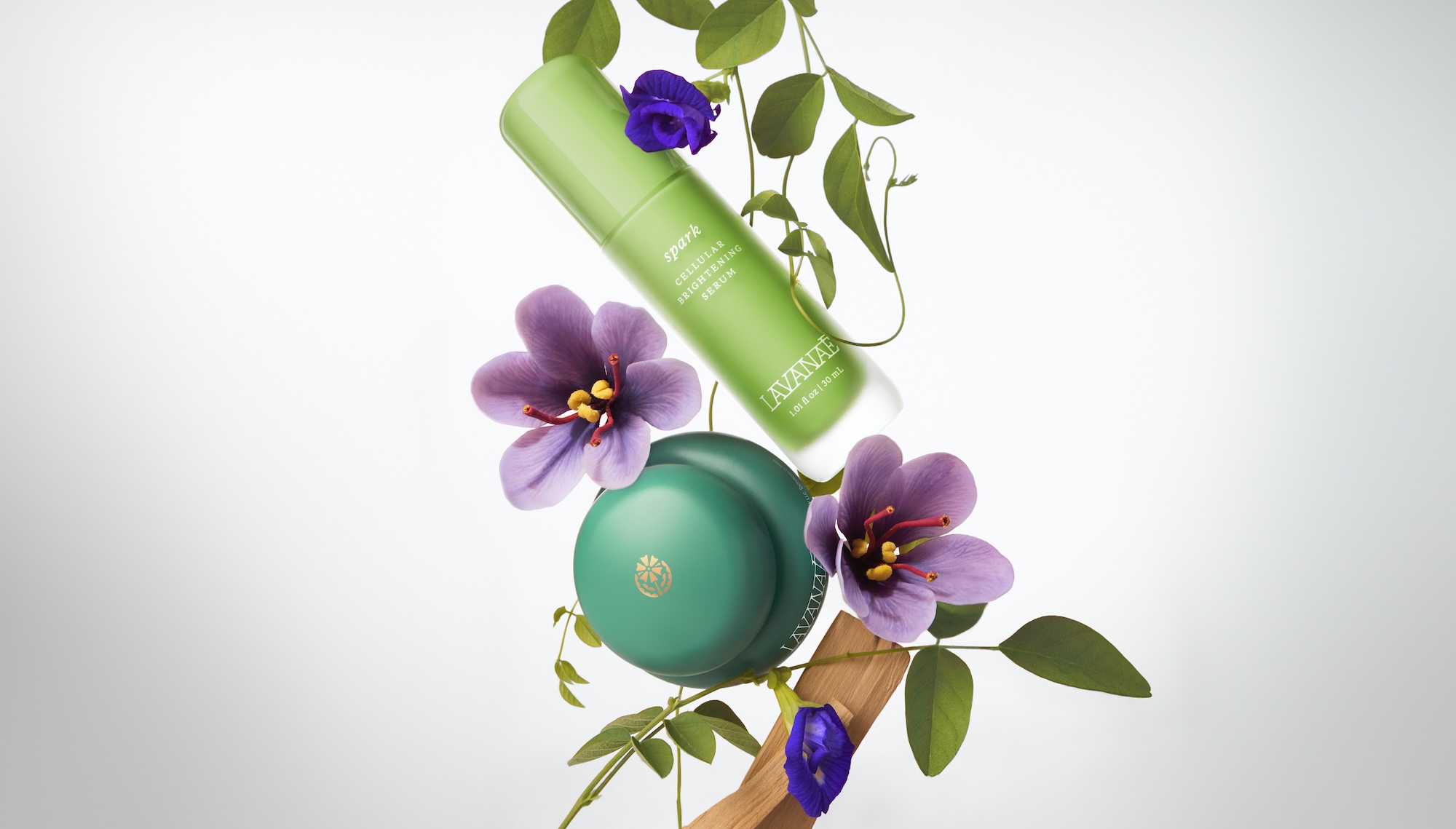
LAVANAĒ is launching with two products that Lavania formulated herself over two years of R&D with board-certified dermatologist Shikha Shah. The $125 30 ml. Spark Cellular Brightening Serum pairs liposomal glutathione, amla and niacinamide with saffron, butterfly pea flower, Indian sandalwood, peptides and a multi-layer hydration complex to target uneven tone, dehydration and firmness. The $105 50 ml Seal Barrier Reset Cream combines ceramides, cholesterol and omega fatty acids with bakuchiol, ashwagandha and gotu kola to replenish lipids, reinforce the moisture barrier and calm stressed skin.
Both formulas contain a proprietary six-ingredient complex DESC-6 blending Ayurvedic botanicals and modern actives. Lavania identified seven interconnected pathways that contribute to major skin concerns, such as aging, dullness, dehydration, and more. Each product targets four to five of them, and together they address all seven.
The products underwent repeat insult patch testing, consumer perception testing and instrumental testing. They’re formulated without mica, silicones, artificial colors and synthetic fragrance, and they come in Italian-made packaging. The founder doesn’t approach pricing with a firm ceiling in mind. “But,” she says, “we want to make sure that whatever we are offering, the customer would say, ‘This is the best I can get at this price point.’”
The brand is selling direct-to-consumer and will stay focused on the U.S. for the next few years. Lavania wants to gather customer data and feedback firsthand before entering retail. The founder is wary of overextending the assortment. “Whatever we launch going forward, it will be part of the whole system,” she says, “[not] just for the sake of launching a new product.

LAVANAĒ enters a category Beauty Independent has followed for nearly a decade. Brands including Ranavat, founded by engineer-turned-entrepreneur Michelle Ranavat; Toronto-based Sahajan, which recently refreshed its packaging and sells at Sephora Canada and Credo; London-based Urban Veda, which made its U.S. debut at Ulta Beauty; yoga studio-focused Soma Ayurvedic; Wild Grace; and hair and scalp care brand Squigs have all built businesses on Ayurvedic ingredients and rituals. Lavania sees her brand as an evolution of that wave. “Most of the brands you’ll see in the U.S. focus on Ayurvedic rituals [and] botanicals,” she says. “We are bringing a new philosophy for skincare.”
The launch also arrives as global beauty conglomerates pour money into the Indian beauty market. In June, L’Oréal agreed to acquire a majority stake in Innovist, the house behind Bare Anatomy, Chemist at Play and Sunscoop, marking its first Indian acquisition since Cheryl’s Cosmeceuticals in 2013. In March, The Estée Lauder Companies agreed to buy the remaining stake in luxury Ayurvedic brand Forest Essentials, which it first invested in in 2008. Puig took a majority stake in Kama Ayurveda in 2022 after a minority investment in 2019. And in September, L’Oréal’s corporate venture capital arm, BOLD, and Indian beauty retailer Nykaa teamed up to take minority stakes in emerging Indian beauty and wellness brands. India’s beauty and personal care market is projected to reach $34 billion by 2028, according to the India Brand Equity Foundation.
Indian brands are increasingly crossing over to the U.S., too. In March, influencer Diipa Büller-Khosla’s Ayurveda-inspired brand indē wild became the first homegrown Indian beauty brand at Sephora U.S., rolling out to 178 doors. Astrea Beauty, which draws on Siddha, a traditional South Indian medicine system, debuted in the U.S. this year with products priced at $48. And Indian farm-to-face brand RAS Luxury Skincare raised a $7.5 million series B in March led by Dabur Ventures with participation from Unilever Ventures.
Lavania’s parents were surprised when she decided to leave a successful career to start her own company—kind of. “They always knew that I’d do something big,” she says. “I always said that I want to build my own business one day.”
