
Can Filament Become The Next Billion-Dollar Bond-Building Brand? Leave a comment
After its exclusive retail launch at Violet Grey on Jan. 21, Filament sold through eight weeks of inventory within three hours.
It was an auspicious retail premiere for the science-focused haircare brand and brainchild of Nathan Puksta, a serial entrepreneur who was formerly SVP at L’Oréal, SVP at Kiehl’s Since 1851 and global GM at Baxter of California. Filament is following in the footsteps of science-focused haircare brands that preceded it, including Olaplex and K18, with a treatment-first approach, a proprietary bond-building technology and an eye on the professional channel, even as it edges into retail with Violet Grey, the luxury e-tailer known for its Violet Code stamp of approval awarded to products vetted by its network of A-list industry experts.
“No one can build a brand like Violet Grey, and then you get the seal of expertise,” says Puksta, noting that Violet Grey was drawn to Filament as a marquee haircare brand in its assortment. “They are so big in skin, they’re so big in fragrance. I think they were like, ‘We really need to crack the code on hair. This could be one of our rocket ships for hair.’”
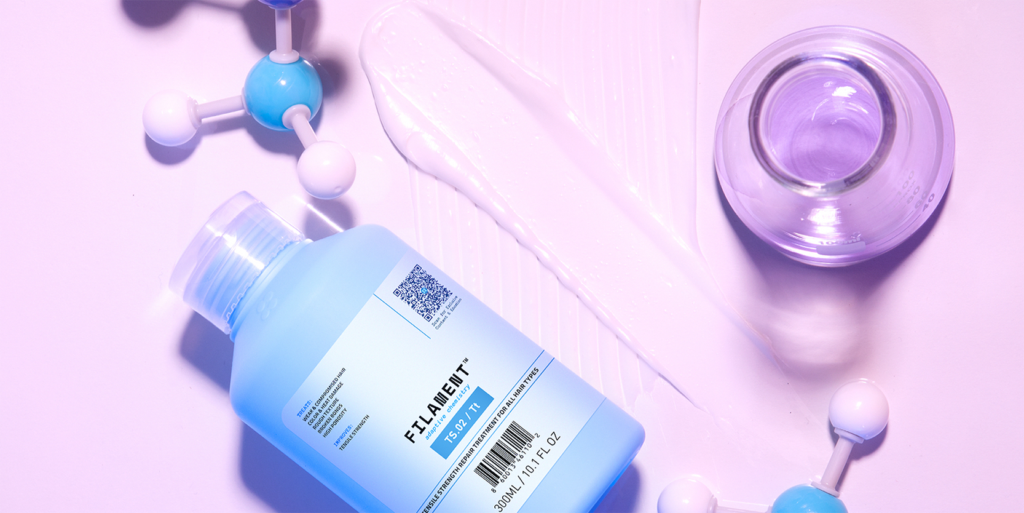
Like Olaplex and K18, which debuted with No.3 Hair Perfector and Leave-In Molecular Repair Hair Mask, respectively, Filament launched on Violet Grey with its $48 TS.02/Tt: Tensile Strength Hair Treatment Mask. The ingredient compound Tensilyx is at the heart of the mask’s formula, and it blends patented long-chain molecules with essential fatty acids, antioxidants and polyphenols to strengthen and smooth hair and help ward off damage and fallout.

Both Olaplex and K18 began in salons before embarking on retail. In July last year, Filament set out on a similar path by entering about 20 salons and dermatologists’ offices. The brand sells a professional version of its mask containing double the concentration of Tensilyx and a formula optimized for performance post-chemical service. It can be offered as a service add-on.
Now, Filament is stepping up its salon distribution with a new strategic partnership with The Four Star Companies, a salon distributor looking to place Filament in the top 2% of salons nationwide or around 3,000 accounts, according to Puksta. An additional 1,000 to 1,500 dermatology and aesthetician clinics are part of Filament’s expansion plan, too. Informed by his extensive background in beauty, Puksta enjoys demonstrating Filament himself in professional settings.
Describing Filament as an advanced professional haircare brand, he emphasizes that its distribution strategy values curation over ubiquity. “From a wholesale and luxury perspective, we only want to work with people that understand how to tell a story,” says Puksta, elaborating, “We care most about what the pro thinks about us…I love being in the salon environment. That’s one of the main reasons on a human level why I started this business.”
“We care most about what the pro thinks about us.”
Puksta has bootstrapped Filament thus far. Though he declined to share how much he spent to launch the brand, he says he chose to prioritize spending on the science behind the product, especially research and development and clinical trials, rather than spending tens to hundreds of thousands on a slick branding agency and website design. Using PowerPoint, Canva and Figma, he handled site construction and branding. “I’m not bankrolled. I don’t have private equity funding,” says Puksta.”This is my life savings.”
Filament may not have to bootstrap for long. Puksta is in conversations with institutional investors and divulges that there’s “strong interest” from several major players. He says, “We’re open to the right opportunity, but the brand is being highly intentional about timing and a partnership fit.”
The bond-building category has been a yellow brick road for haircare startups. Category creator Olaplex had a blockbuster IPO in 2021 at a market capitalization exceeding $15 billion. In 2023, Olaplex competitor K18 was scooped up by Unilever for an estimated value of over $1 billion.
Though Olaplex faltered post-IPO, it was bought by conglomerate Henkel for $1.4 billion last month, showing the industry’s continued bullishness on the science behind brands like Filament. According to market research firm Future Market Insights, the hair bond multiplier market is expected to reach $229.8 million this year and $467.2 million by 2036, growing at a rate of 7.4% over the decade.
